
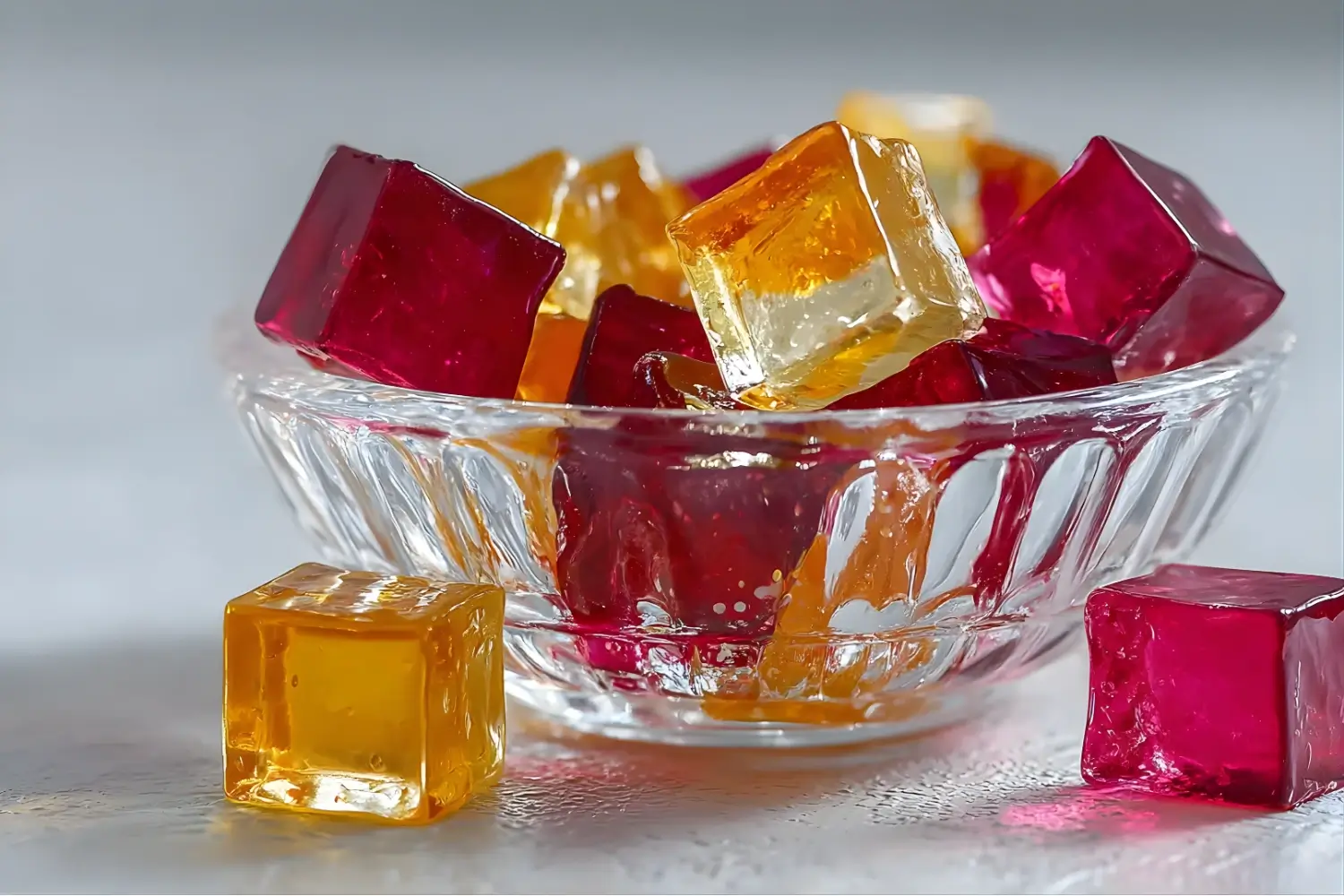

No. Gelatin is made from collagen extracted from the bones, skin and connective tissue of cattle, pigs and horses. It is not vegan, and it is not vegetarian either.
That second part surprises people, because gelatin turns up constantly in products marketed as vegetarian.
What gelatin actually is
Collagen is the structural protein in animal connective tissue. Boiled and processed, it produces gelatin — a gelling agent that sets liquids into a wobble and gives products a particular melt-in-the-mouth texture that plant alternatives don’t replicate exactly.
There’s no plant version. Gelatin is animal-derived by definition. An ingredient labelled gelatin is always animal-derived.
Where you’d expect it
- Gummy candies and marshmallows
- Jelly and jelly desserts
- Some yogurts, particularly low-fat ones
- Panna cotta, mousse, and set desserts
- Aspic and some pâtés
Where you wouldn’t
This is the useful part.
Capsule shells. Most standard two-piece supplement capsules and almost all softgels are gelatin-based. HPMC capsules are the plant-derived alternative, but they look nearly identical.
Fruit juice and cider. Gelatin is used as a clarifying agent to remove haze. It’s filtered out before packaging, which means it generally doesn’t need to be declared under Canadian labelling rules. A clear juice may have been gelatin-clarified with nothing on the label to say so.
Wine and beer. Same principle. Gelatin is one of several traditional fining agents, alongside isinglass from fish swim bladders, casein from milk, and egg albumin.
Some low-fat dairy products, as a thickener.
Icings and glazes, occasionally.
Vitamin and supplement coatings.
Is gelatin vegetarian?
No. It’s derived from slaughtered animals, which puts it outside any standard definition of vegetarian — including ours.
It’s frequently present in products marketed as vegetarian anyway, usually because the manufacturer’s internal definition focused on meat as an ingredient rather than on animal derivation. “Vegetarian” has no legal definition in Canadian food labelling, so there’s nothing preventing it.
What about “fish gelatin”?
Derived from fish skin and scales. Neither vegan nor vegetarian, and it appears in some supplements and confectionery.
Plant-based alternatives
If you’re looking for substitutes:
Agar (agar-agar). From seaweed. Sets firmer than gelatin and sets at room temperature.
Pectin. From fruit. Standard in jams, and used in many vegan gummies.
Carrageenan. From red seaweed. Common in dairy alternatives.
Konjac. From a root vegetable.
None behave identically to gelatin, which is why some products have been slower to reformulate than others.
How to avoid it
Read the panel for gelatin, gelatine, hydrolysed collagen, or collagen.
Check capsules specifically if you take supplements — look for “vegetarian capsule” or “HPMC.”
Look for a certification mark on beverages, where clarifying agents won’t appear on the label at all. This is the one case where careful label reading genuinely can’t help you.
Fining agents like gelatin are one of several categories of ingredient that never reach the label. We’ve written more about where they hide, and our full prohibited ingredients list sets out everything we screen for.


Leave a Reply